
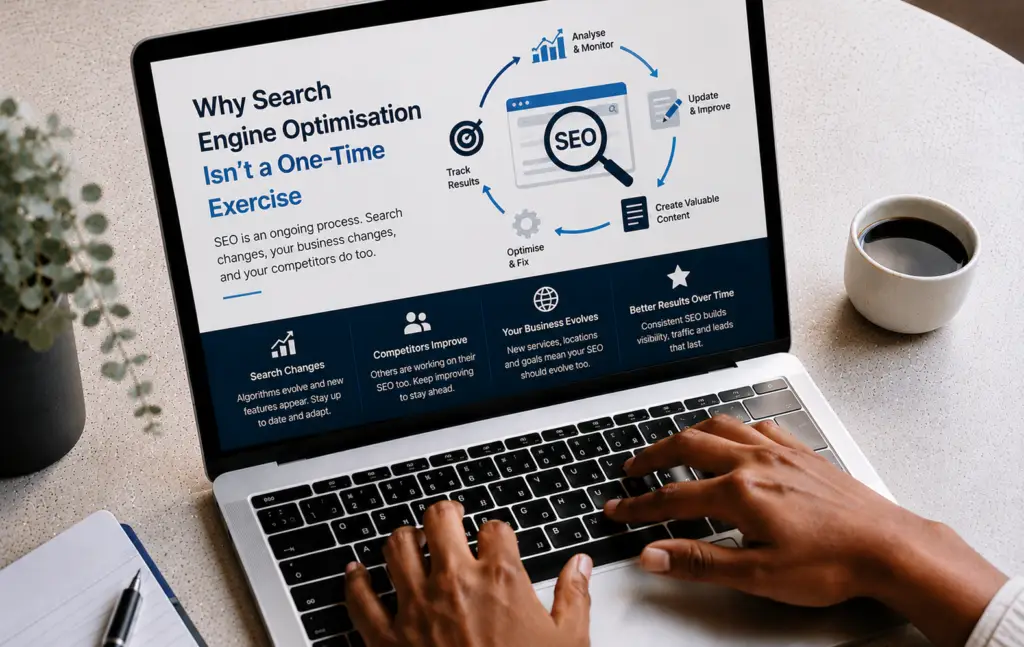
One of the biggest misconceptions about SEO is that you optimise a website once, achieve good Google rankings and then move on.
Unfortunately, search engine optimisation doesn’t work that way.
Your competitors change. Your customers change. Your website changes. Most importantly, Google Search continues to evolve.
In fact, Google regularly updates its search systems and documentation. In 2026 alone, Google introduced further changes relating to AI search experiences, structured data, Search Console and other search features. (Google for Developers)
Therefore, SEO should be viewed as an ongoing process rather than a once-off website task.
The businesses that perform well over the long term generally don’t optimise their websites and forget about them. Instead, they monitor performance, improve existing pages and respond to new opportunities.
What Does Ongoing SEO Actually Mean?
Ongoing SEO doesn’t mean changing your website every day.
Instead, it involves regularly assessing how your website performs and making improvements where they can add value.
This might include:
- Monitoring Google rankings
- Reviewing Search Console data
- Improving existing pages
- Creating new service content
- Updating outdated information
- Finding new keyword opportunities
- Improving internal links
- Checking technical SEO issues
- Optimising page titles and descriptions
- Improving website speed
- Monitoring competitors
- Building useful new content
- Reviewing local search visibility
Some months may require substantial work. Meanwhile, others may involve smaller improvements.
The important thing is that your SEO strategy continues to evolve.
Google Search Continues to Change
Google doesn’t use one fixed ranking formula that remains unchanged for years.
Its search systems continually evolve.
Google’s own documentation now makes clear that updates to its search algorithms happen continuously, including smaller core updates between the more noticeable major changes. (Google for Developers)
Therefore, something that performed well several years ago may not necessarily be the strongest approach today.
This doesn’t mean you should panic every time Google announces an update.
Instead, focus on maintaining a technically sound website with useful content that genuinely helps your customers.
Then, when search behaviour or Google’s systems change, you have a much stronger foundation from which to adapt.
Your Competitors Are Doing SEO Too
SEO doesn’t happen in isolation.
Imagine your website currently ranks third for website design Ballito.
You might decide that’s good enough and stop optimising the page.
However, the businesses below you aren’t necessarily standing still.
A competitor could redesign its website, improve its service pages, publish better content or strengthen its local search presence.
Eventually, its page may become a stronger result than yours.
Therefore, maintaining rankings can require work just as achieving them does.
SEO isn’t only about catching competitors.
It’s also about making it harder for competitors to catch you.
Search Behaviour Changes
The way customers search evolves over time.
New terminology appears. Products change. New technologies emerge and customers become more knowledgeable.
Consider artificial intelligence.
A few years ago, relatively few businesses were actively targeting searches relating to AI website design or AI-assisted web development.
Today, those topics create entirely new opportunities.
Therefore, keyword research shouldn’t happen once when a website launches and then never again.
Regularly reviewing search behaviour can reveal new services, questions and topics your potential customers care about.
Your Business Changes Too
Your website isn’t the only thing evolving.
Your business may introduce new services, stop offering others or move into new geographic markets.
Perhaps you originally only served Ballito.
Later, you may decide to actively target customers in Umhlanga and Durban.
Your SEO strategy needs to reflect that change.
Likewise, if a new service becomes an important source of revenue, it may deserve its own optimised landing page rather than being mentioned briefly on a general services page.
SEO should support the business you operate today, not the business you had when the website was originally built.
Your Website Keeps Changing
WordPress websites rarely remain completely static.
You add pages.
Products change.
Blog articles get published.
Plugins get updated.
Images get replaced.
URLs sometimes change.
All these changes can potentially affect SEO.
For example, deleting or changing an important URL without correctly redirecting it can affect existing search visibility.
Google recommends mapping old URLs to their relevant replacements when URLs change, implementing permanent redirects and monitoring performance afterwards through Search Console. (Google for Developers)
Therefore, ongoing SEO also involves protecting the work you’ve already done.
Content Doesn’t Stay Fresh Forever
Some website content remains relevant for years.
Other content becomes outdated surprisingly quickly.
Prices change. Services evolve. Technology moves forward. Statistics become old and external links stop working.
Therefore, existing content should occasionally be reviewed.
Ask:
Is this information still accurate?
Does this page still answer the customer’s question?
Are there new questions we should answer?
Does the page represent our current service?
Could the content be clearer or more useful?
Updating an existing strong page can sometimes provide more value than publishing another article simply because you feel you need something new.
SEO Isn’t About Publishing Endless Blog Posts
Ongoing SEO doesn’t mean publishing three generic articles every week.
Quality matters far more than filling a content calendar.
Your website should answer the questions potential customers genuinely ask.
For example, a web development company might publish articles such as:
Why WordPress Web Design Is Still the Best Choice in 2026
What You Need to Know About Good Website Hosting
SEO for Online Shops in South Africa
Using AI in Web Development
Why Your Website Must Fit Your Corporate Image
These topics support the company’s core services while answering genuine questions customers may have.
Therefore, blog content should strengthen the overall website rather than exist simply to generate another URL.
Existing Pages Can Reveal New SEO Opportunities
One of the advantages of an established website is data.
Once your pages have been appearing on Google for a while, you can see how people actually find them.
Google Search Console can reveal:
- Search queries
- Impressions
- Clicks
- Average positions
- Popular pages
- Changes in search performance
This information can identify opportunities you didn’t anticipate when the website was created.
For example, a page might receive many impressions for a relevant phrase but relatively few clicks.
That could indicate an opportunity to improve the page title, content or search positioning.
Google continues to expand Search Console’s performance tools, including new ways to analyse how content performs across Search and other platforms. (Google for Developers)
Therefore, ongoing SEO becomes increasingly data-driven as your website matures.
Local SEO Needs Ongoing Attention
Local SEO is particularly important for businesses targeting customers in specific locations.
For The Digital Nomad, that means concentrating primarily on searches in Ballito, while also building visibility in Umhlanga and Durban.
Potential searches could include:
Website design Ballito
Web designer Ballito
SEO Ballito
WordPress hosting Ballito
Logo design Ballito
However, local competition changes.
New businesses appear, existing competitors improve their websites and customer search behaviour evolves.
Therefore, local SEO needs regular monitoring and refinement.
You Shouldn’t Create Identical Pages for Every Town
Ongoing local SEO doesn’t mean creating hundreds of almost identical pages with different town names.
For example:
/website-design-ballito/
/website-design-umhlanga/
/website-design-durban/
can make sense only when each page provides genuine, location-specific value.
Simply duplicating the same content and replacing “Ballito” with “Umhlanga” doesn’t create a useful experience.
Instead, focus primarily on the areas that genuinely matter to your business.
For The Digital Nomad, Ballito can remain the primary geographic focus, while Umhlanga and Durban appear naturally where relevant.
Technical SEO Requires Maintenance
Even a technically perfect website won’t necessarily stay perfect.
Plugins change.
WordPress changes.
Server technology changes.
Pages get deleted.
Links break.
Redirect chains develop.
Large images get uploaded.
Therefore, technical SEO deserves periodic review.
Typical checks might include:
- Broken links
- 404 errors
- Redirects
- Indexing problems
- Sitemap issues
- Duplicate pages
- Canonical URLs
- Mobile usability
- Page performance
- HTTPS
- Structured data
You don’t necessarily need to obsess over every technical metric.
However, problems should be identified before they begin affecting large parts of the website.
Internal Linking Should Evolve
Internal links help visitors move through your website.
They also help search engines understand how your pages relate to one another.
However, websites naturally become less organised as they grow.
An article published three years ago obviously couldn’t link to a service page you created yesterday.
Therefore, periodically revisit older content and look for useful internal-link opportunities.
For example, an article about SEO for online shops could naturally link to your Online Shopping Websites and Search Engine Optimisation services.
Likewise, your WooCommerce service page could link back to useful supporting articles.
Over time, this creates a stronger network of relevant content.
Your Search Results Need Monitoring
SEO isn’t finished when you reach page one.
You need to understand what happens afterwards.
Are people clicking your result?
Are they visiting the right landing page?
Are rankings improving or declining?
Which searches generate enquiries?
Which pages receive impressions but few clicks?
Search Console exists specifically to help website owners understand how their content performs in Google Search. (Google for Developers)
Therefore, SEO decisions should increasingly rely on real performance data rather than assumptions.
AI Is Changing Search
Search is undergoing another major evolution.
Google has expanded AI-driven search experiences and, in 2026, published additional guidance specifically addressing optimisation for generative AI features.
Importantly, Google says established SEO best practices remain relevant to these experiences. It also places emphasis on useful, original and non-commodity content. (Google for Developers)
Therefore, businesses don’t need to abandon SEO and chase every new acronym.
The fundamentals still matter.
Create useful content.
Make your website accessible to search engines.
Explain your services clearly.
Build a strong brand.
Provide a good user experience.
Then adapt your strategy as search continues to evolve.
SEO and Website Design Should Work Together
SEO shouldn’t be something you add after your website has been built.
Website design decisions can affect:
- Navigation
- Page hierarchy
- URLs
- Internal linking
- Mobile usability
- Page speed
- Content structure
- Calls to action
Therefore, SEO works best when considered as part of the website itself.
Likewise, when redesigning an established website, you need to protect existing SEO value.
Changing URLs, removing content or restructuring navigation without understanding existing search performance can create unnecessary problems.
Google specifically advises carefully planning URL changes, implementing redirects and monitoring Search Console during website migrations. (Google for Developers)
SEO Isn’t Only About Rankings
Getting to number one feels good.
However, rankings aren’t the ultimate objective.
Business results are.
A website could rank first for ten irrelevant phrases and generate no meaningful enquiries.
Meanwhile, another website might rank third for one highly commercial search and generate new customers every month.
Therefore, ongoing SEO should look beyond positions.
Consider:
Are the right people finding the website?
Are visitors engaging with the content?
Are they contacting the business?
Are online-shop visitors buying products?
Which pages contribute to actual business results?
SEO should support your business rather than becoming a competition for impressive-looking reports.
How Often Should You Work on SEO?
There isn’t one schedule that suits every website.
A large online shop may require frequent SEO work because products, categories and competitors constantly change.
Meanwhile, a smaller service business may need less frequent intervention.
However, every business website should be reviewed regularly.
A practical approach might include ongoing performance monitoring, periodic content improvements and scheduled technical reviews.
The important thing is consistency.
Doing sensible SEO work throughout the year is generally more useful than ignoring your website for three years and then trying to fix everything at once.
Think of SEO as Building an Asset
SEO tends to become more valuable when improvements accumulate.
One useful service page becomes five.
Five informative articles become twenty.
Internal links become stronger.
Google gathers more information about your website.
Your brand becomes more established.
Your understanding of customer search behaviour improves.
Therefore, good SEO isn’t simply another monthly marketing activity.
You’re gradually building a search asset around your business.
When Can You Stop Doing SEO?
You can reduce SEO activity when you’ve achieved strong visibility and there are fewer meaningful opportunities to pursue.
However, completely ignoring search performance is rarely sensible.
Even established websites should monitor rankings, traffic, technical health and competitors.
Think of it like maintaining a successful physical shop.
Once customers start coming through the door, you don’t remove the signage, stop maintaining the building and assume everything will remain exactly the same forever.
Your online presence deserves the same attention.
Looking for Ongoing SEO in Ballito?
SEO isn’t something you tick off a website checklist and forget.
It requires monitoring, improvement, useful content and adaptation as your business, competitors and Google Search continue to evolve.
The Digital Nomad provides Search Engine Optimisation in Ballito, helping businesses improve their visibility for the services and locations that matter to them.
We also provide SEO services for businesses targeting Umhlanga, Durban and customers throughout South Africa.
Whether your website is brand new or has been online for years, we can identify opportunities to improve its search visibility and strengthen its long-term performance.
Want more customers to find your business on Google? Talk to The Digital Nomad about an ongoing SEO strategy built around real searches and sustainable growth.