
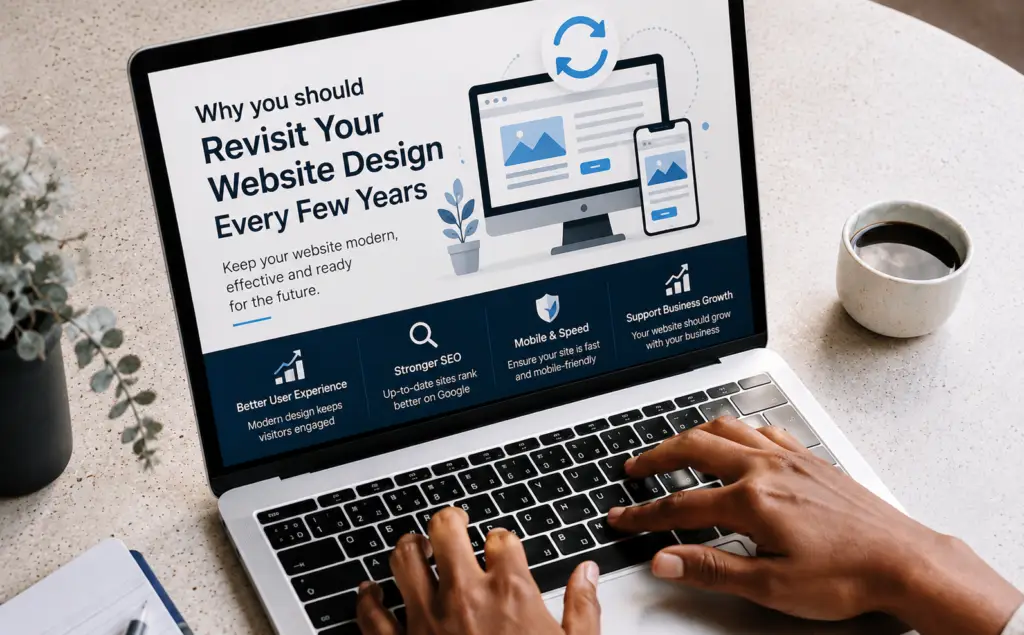
Your website is often the first interaction a potential customer has with your business. However, a website that looked modern and performed well three or four years ago may no longer meet today’s expectations.
Technology changes quickly. Likewise, customer behaviour, mobile devices, search engines and website design trends continue to evolve. Your own business may also offer different products or services from when you first launched the site.
Therefore, revisiting your website design every few years isn’t simply about giving it a fresh look. It’s an opportunity to improve performance, strengthen your brand and make sure your website still supports your business goals.
Your Website Can Start to Look Outdated
Website design trends change gradually, so you may not immediately notice your site becoming dated.
However, potential customers often do.
Older layouts, oversized sliders, dated typography and cluttered pages can make a business appear less current than its competitors. In contrast, clean navigation and modern layouts can create an immediate sense of professionalism.
You don’t need to follow every design trend. Instead, your website should feel contemporary while remaining consistent with your corporate identity.
Your Business Has Probably Changed
Think about your business when your current website was first designed.
Do you offer exactly the same services? Are you targeting the same customers? Have your team, locations, products or priorities changed?
For many businesses, the answer is no.
Therefore, your website needs to evolve alongside your company. A redesign gives you the opportunity to review your content and make sure it accurately represents the business you operate today.
Moreover, you can give greater prominence to the products or services that now generate the most value.
Mobile Website Design Keeps Evolving
Having a “mobile-friendly” website is no longer enough.
People expect websites to be genuinely easy to use from a phone. Buttons need to be easy to tap, text needs to be readable and navigation should feel effortless.
Therefore, reviewing an older website on current smartphones can reveal problems that weren’t obvious when the site was originally created.
A modern responsive redesign can improve the experience across smartphones, tablets, laptops and larger desktop screens.
Website Speed Matters
Modern websites often accumulate unnecessary baggage over time.
For example, you may have installed plugins that you no longer use. Images may be unnecessarily large, while old scripts and page-builder elements can add additional weight.
Consequently, a website that was once fast can gradually become slower.
A redesign provides an opportunity to review the technology behind the site as well as its appearance. Faster loading can improve the visitor experience and support your wider SEO efforts.
Your SEO Strategy May Need Updating
SEO doesn’t stand still.
Google continues to change Search and its documentation, while website owners now need to consider traditional results alongside newer search experiences. Google also recommends using Search Console and Google Analytics together to understand how visitors discover and experience a website.
Therefore, redesigning a website creates an excellent opportunity to reconsider its SEO structure.
You can review page headings, service pages, internal links, metadata, content and keyword targeting. Additionally, local businesses can strengthen pages around the locations where they actually want to attract customers.
For example, a business targeting Ballito, Umhlanga and Durban should make sure its website clearly communicates both its services and relevant geographic areas.
However, a redesign needs careful SEO planning. If existing URLs change, Google recommends mapping old URLs to their replacements and implementing appropriate redirects.
Your Content Deserves a Review Too
A website redesign shouldn’t involve copying every paragraph from your old site onto a prettier template.
Instead, ask whether the content still answers the questions potential customers have.
Are your services clearly explained? Does each important service have its own page? Are your calls to action obvious? Most importantly, does the website explain why someone should choose your business?
Freshening your content can make the new design considerably more effective.
Security and Technology Change
If your website runs on WordPress, the platform itself continues to evolve. WordPress 7.1, for example, introduced further accessibility and performance improvements in 2026.
Security also requires ongoing attention. WordPress released security updates during 2026 and recommended that website owners update affected installations promptly.
Therefore, an older website shouldn’t simply be left untouched because it still appears to work.
A redesign gives your developer an opportunity to review the underlying setup, remove outdated components and build on a more current foundation.
Your Competitors Aren’t Standing Still
Your website doesn’t exist in isolation.
While you may be happy with your current site, competitors could be investing in better websites, stronger SEO, faster online stores and more useful content.
Therefore, review competing websites occasionally.
Don’t copy them. Instead, look at the experience from your customer’s perspective. If competitors make it considerably easier to understand their services, view their work or request a quote, your website may need attention.
Better Design Can Improve Conversions
More traffic isn’t always the answer.
Sometimes your website already attracts potential customers but doesn’t do enough to convert them.
A redesign allows you to reconsider the complete customer journey.
For example, you can make contact buttons more prominent, simplify navigation and improve service-page layouts. Likewise, stronger calls to action can encourage visitors to take the next step.
As a result, your existing traffic may become considerably more valuable.
How Often Should You Redesign Your Website?
There isn’t a rule that says every website needs replacing after a specific number of years.
Instead, review your website every two to three years and ask whether it still performs effectively.
You may only need smaller improvements. However, if the design looks dated, the technology has become cumbersome or the content no longer represents your business, a more substantial redesign could make sense.
Above all, don’t redesign your website simply because the calendar says it’s time.
Redesign it when doing so will create a better experience for your customers and a stronger platform for your business.
Is It Time to Revisit Your Website?
Your website should evolve with your business rather than becoming a snapshot of what your company looked like several years ago.
If your website feels dated, performs poorly or no longer reflects your business, now may be the right time to rethink it.
The Digital Nomad provides professional website design and website redesign services in Ballito, Umhlanga and Durban, with a focus on modern WordPress websites, SEO and long-term performance.
Ready for a fresh look? Let’s turn your existing website into one that better represents where your business is going next.